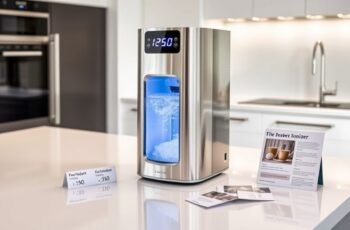
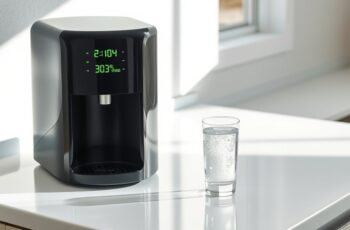
While high power consumption might suggest more effective ionization, it doesn’t always guarantee better performance; in fact, many factors influence a water ionizer’s efficiency. Understanding the relationship between energy use and ionization quality requires a closer look at device design, water conditions, and technological advancements. Exploring these elements can help us determine whether investing in a more powerful model truly benefits us or if smarter energy management offers a better solution.
Key Takeaways
- Water ionizers typically use between 100-300 watts during operation, depending on model and features.
- Power consumption is influenced by electrode size, water flow rate, and voltage control.
- Higher mineral content in water increases electrical resistance, leading to higher energy use.
- Modern ionizers adjust power dynamically based on water quality, optimizing efficiency.
- Proper maintenance and operational strategies help reduce unnecessary energy consumption.
How Much Power Do Water Ionizers Use During Operation?
Water ionizers typically operate within a power range of 100 to 300 watts during active use, depending on the model and the specific functions engaged. This power consumption stems primarily from the electrolysis process, where electrical current splits water molecules to produce ionized water. Lower-end models tend to consume around 100-150 watts, optimized for basic ionization functions. Higher-end units with advanced features, such as multiple pH settings or higher flow rates, can draw up to 300 watts. The power usage is directly linked to the electrolysis plates’ size, the voltage applied, and the duration of operation. Precise power management guarantees efficient ionization while minimizing energy waste. Understanding this range helps users gauge operational costs and energy efficiency in various application scenarios.
Factors That Influence Water Ionizer Energy Consumption
Water quality directly affects ionizer energy consumption by influencing electrode efficiency and mineral load. Device efficiency factors, such as design and maintenance, also play a vital role in determining power use. Understanding these variables helps optimize energy management for consistent performance.
Water Quality Impact
How does water quality influence the energy demands of a water ionizer? Variations in mineral content, particularly hardness levels, markedly impact power consumption. High mineral concentrations require the ionizer to exert more electrical energy to achieve the desired ionization levels, as mineral deposits increase resistance within electrodes. Additionally, water with elevated impurities can cause fouling and scaling, reducing electrode efficiency and necessitating higher voltages to maintain performance. Conversely, softer water with fewer mineral contaminants demands less energy, as less effort is needed to separate ions. Thus, fluctuations in water composition directly correlate with increased or decreased power requirements. Monitoring and adjusting for water quality are essential for optimizing energy efficiency, as inconsistent mineral loads impose variable electrical demands on the ionization process.
Device Efficiency Factors
Device efficiency markedly influences the energy consumption of water ionizers, with various design and operational factors playing pivotal roles. Enhancement depends on key elements such as:
- Electrode Material and Surface Area – Higher-quality electrodes with larger surfaces improve ionization efficiency, reducing power needs.
- Cell Design and Water Flow Rate – Streamlined cell configurations and appropriate flow rates minimize energy waste during ionization.
- Power Supply Modulation – Adjustable voltage control ensures energy is used only as needed, avoiding unnecessary power draw.
- Insulation and Heat Management – Effective thermal insulation reduces energy lost to heat, maintaining superior operation with lower energy input.
Understanding these factors helps us assess and enhance device efficiency, ultimately reducing power consumption in water ionization processes.
Comparing Power Usage Across Different Water Ionizer Models
While evaluating the energy efficiency of water ionizers, it’s important to take into account the variability in power consumption across different models. Studies reveal significant differences in wattage, with some units operating around 100-150 watts during ionization, while others exceed 200 watts. These discrepancies often result from variations in electrode design, processing capacity, and additional features like UV sterilization or digital displays. Analyzing power draw relative to output volume helps clarify efficiency metrics; for example, models with higher wattage aren’t necessarily more efficient if they produce less alkaline or acidic water per energy unit. Understanding these differences enables us to compare models objectively, emphasizing the importance of balancing power consumption with performance and intended usage to optimize operational costs and energy efficiency.
How to Measure and Monitor Your Water Ionizer’s Power Consumption
To accurately assess your water ionizer’s power consumption, we need to employ precise measurement methods that capture real-time energy usage. Monitoring involves selecting appropriate tools and systematic procedures to ensure data accuracy.
Accurate power assessment requires real-time energy monitoring with precise tools and systematic procedures.
- Use a Clamp Meter: Attach it around the power cord to measure current flow without disconnection.
- Employ a Kill-A-Watt Meter: Plug the ionizer into this device to record voltage, current, and power draw directly.
- Record Over Time: Take readings at different operational stages—startup, steady state, and shut down—to identify consumption patterns.
- Analyze Data Logs: Use software or manual calculations to interpret the collected data, focusing on average and peak power usage for comprehensive assessment.
These steps enable precise, real-time monitoring essential for optimizing energy efficiency.
Tips for Reducing Energy Use Without Compromising Water Quality
Enhancing energy consumption in your water ionizer involves strategic adjustments that do not compromise the quality of the water produced. We recommend implementing operational habits that reduce power use while maintaining peak ionization levels. For example, scheduling operation during off-peak hours or turning the device off when not in use minimizes unnecessary energy expenditure.
| Strategy | Rationale |
|---|---|
| Use timers or delays | Prevents continuous operation, conserving energy |
| Limit high-intensity cycles | Reduces power without affecting water mineralization |
The Impact of Water Ionizer Settings on Energy Efficiency
Adjusting the settings on a water ionizer directly influences its energy consumption, as different configurations require varying power levels to operate effectively. Optimizing these settings can notably improve energy efficiency by balancing performance with power use.
Consider these factors:
- Electrode polarity and current: Higher polarity reversals or increased current boost ionization but consume more energy.
- Water flow rate: Slower flow rates extend contact time, requiring more power for sustained ionization.
- pH level targets: Achieving higher pH levels demands increased energy input to generate more alkaline ions.
- Pre-set modes: Some modes prioritize energy savings, reducing power during less demanding operations.
Careful calibration of these parameters ensures efficient operation while maintaining water quality, minimizing unnecessary energy expenditure.
Are More Expensive Water Ionizers More Energy-Efficient?
While higher-priced water ionizers often incorporate advanced features and premium components, their cost does not automatically guarantee superior energy efficiency. Energy consumption is primarily determined by the design of the electrolysis chamber, power supply efficiency, and control systems. More expensive models may include sophisticated circuitry and sensors that optimize power usage based on water quality and user settings, potentially reducing energy waste. However, they can also feature larger or more powerful components that consume more energy without necessarily improving efficiency. It’s essential to analyze specific technical specifications, such as power ratings and efficiency ratings, rather than relying solely on price. Ultimately, costlier models may offer efficiency gains, but these are not inherent and depend on the engineering and optimization of each unit.
Common Myths About Water Ionizer Power Usage Debunked
Many common beliefs about water ionizer power usage are actually misconceptions that can lead consumers to overlook important technical details. Here are four myths debunked:
- Higher power always means better performance – Not necessarily; efficiency depends on electrode design and processing technology.
- Power consumption correlates directly with water quality – Quality depends on multiple factors; power use alone doesn’t determine purification effectiveness.
- Lower wattage units are inherently inefficient – Many low-watt models optimize energy use without sacrificing ionization capacity.
- Power usage remains constant during operation – Modern ionizers adjust power dynamically based on water conditions, making static assumptions unreliable.
Understanding these misconceptions helps clarify the true relationship between power consumption and device performance, emphasizing the importance of technical design over simplistic assumptions.
How to Balance Performance and Energy Costs in Your Water Ionizer
Balancing performance and energy costs in your water ionizer requires a strategic approach that considers both device capabilities and operational efficiency. Optimizing electrode usage and adjusting output settings can reduce energy consumption without sacrificing ionization quality. Regular maintenance—such as cleaning electrodes and replacing filters—ensures consistent performance and prevents unnecessary energy drain caused by buildup or malfunction. Implementing usage schedules based on water demand helps avoid continuous operation, lowering energy costs during idle periods. Evaluating your ionizer’s energy efficiency ratings and selecting models with better power management features can provide long-term savings. Ultimately, a data-driven approach—monitoring power consumption and adjusting settings accordingly—enables a balance that maintains desired water quality while minimizing energy expenditure.
Future Trends in Water Ionizer Technology and Energy Efficiency
Advancements in water ionizer technology are increasingly focused on improving energy efficiency through innovative design and smarter operation. Future trends suggest several key developments:
Innovative designs and smart technology are driving water ionizer energy efficiency forward.
- Smart Sensors and Automation: Incorporating real-time monitoring to optimize power usage based on water quality and usage patterns.
- Enhanced Electrode Materials: Developing durable, low-resistance electrodes to reduce energy consumption during ionization.
- Energy Recovery Systems: Implementing mechanisms that reuse heat and electrical energy, minimizing overall power demands.
- AI-Driven Controls: Using artificial intelligence to adapt operational parameters dynamically, maximizing efficiency while maintaining performance.
These innovations aim to balance performance with sustainability, reducing energy footprints without compromising water quality or device longevity.
Frequently Asked Questions
Do Water Ionizers Consume More Power When Producing Higher pH Levels?
Yes, water ionizers consume more power producing higher pH levels because increasing pH involves applying higher voltage and current, which demands more energy for electrolysis, resulting in greater power consumption during the process.
How Often Should I Run My Water Ionizer to Optimize Energy Efficiency?
We recommend running our water ionizer for about 3-5 minutes per session, optimizing energy efficiency by avoiding unnecessary prolonged usage; studies suggest short, frequent uses conserve power while maintaining performance and water quality standards.
Are There Specific Brands Known for Lower Energy Consumption?
Brands like Kangen, Tyent, and Water Ionizer Expert are known for lower energy consumption due to advanced power management systems, efficient electrode designs, and optimized circuitry, enabling us to operate effectively while minimizing energy use in our water ionizers.
Can I Use a Timer to Reduce Power Usage During Off-Peak Hours?
Yes, you can use a timer to optimize power consumption during off-peak hours; it automates operation, reduces electricity costs, and enhances efficiency, making it a practical solution for managing water ionizer energy use effectively.
Does Water Hardness Affect the Power Consumption of a Water Ionizer?
Water hardness can increase power consumption by up to 20%, as mineral buildup forces ionizers to work harder. We analyze mineral content regularly to optimize efficiency, ensuring consistent performance and energy savings in our water ionizer systems.
Conclusion
Understanding water ionizer power usage involves analyzing multiple factors, from device design to water quality. While higher wattage may suggest stronger ionization, efficiency and real-time adjustments often matter more. By monitoring consumption and making informed choices, we can optimize performance without excess energy costs. Isn’t it more about smart technology and maintenance than just wattage? Balancing these elements guarantees we get clean, healthy water while managing energy effectively.